What is the USMLE?
The United States Medical Licensing Examination (USMLE) is a three-part testing program for physicians desiring to practise medicine in the United States. This evaluates a physician's medical knowledge and clinical skills in order to ensure that patients receive safe care.
Do you want a medical license in the US? Then this exam is required for both US medical graduates and international medical graduates (IMGs).
What Does the USMLE Test?
Each step tests different areas of a Doctor's training and skill:
Step 1
Tests basic medical sciences, such as anatomy, physiology, pathology, pharmacology and microbiology. It assesses how well candidates apply these subjects with the use of clinical cases.
Step 2 CK (Clinical Knowledge)
tests clinical knowledge, ability to diagnose conditions, select tests and plan patient care.
Step 3
Evaluates the ability of physicians to use medical knowledge and clinical judgment without supervision to care for patients.
The USMLE Examination steps are a requirement for international medical graduates (IMGs) to pass in order to receive ECFMG certification, medical residency training, and medical licensure in the United States. Eligibility/Criteria and requirements differ for each stage.
Who Conducts USMLE & How the Exam Is Structured
The Authorities Behind the Exam
You can trust the USMLE exam authority. It isn't run by a single company - instead, two bodies are responsible for administering the United States Medical Licensing Examination (USMLE): the National Board of Medical Examiners (NBME) and the Federation of State Medical Boards (FSMB). Such dual regulation of NBME USMLE and FSMB USMLE means that the exam is standardized and strictly administered.
A Standardized, Computer-Based Test
The USMLE exam system is a standardized and computer-based format. This implies that all the candidates are tested under the same testing conditions and question formats. You will take it at a secure Prometric test center, ensuring a consistent and secure experience no matter where you are in the world.
USMLE Test Structure and Steps
| Steps |
About Exam |
| USMLE Step 1 |
8-hour test with a maximum of 280 questions broken up into 14 blocks of 30 minutes (20 questions each, 280 total). It is now a pass/fail exam. |
| USMLE Step 2 CK |
9-hour exam, 16 blocks of 30 minutes (18–20 questions each), 316 questions total (maximum), effective May 7, 2026. |
| USMLE Step 3 |
Two-day exam, with :
- Day 1 (FIP) has 12 blocks of 18-20 multiple-choice questions (MCQs) in 7 hours. 232 total questions.
- Day 2 (ACM) includes 9 blocks of 20 MCQs and 13-14 CCS cases in 9 hours. 180 total questions.
|
USMLE Step 1 Exam
Think of USMLE Step 1 as testing the core science behind medicine. The USMLE Step 1 examinations cover the understanding of the fundamentals of medical sciences such as pathology, pharmacology and anatomy. Read our guide: how to prepare for USMLE Step 1.
- What It Tests: It tests your level of understanding on how to make use of the basic knowledge to diagnose and know how diseases develop.
- Subject Focus: The exam has a systems-based focus in that an integrated approach is being tested and you have to relate concepts across disciplines.
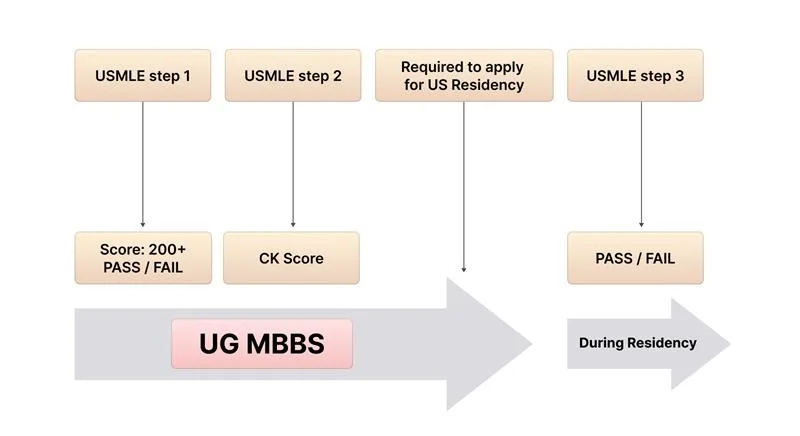
- Why It Still Matters: As of January 26, 2022, the USMLE Step 1 exam officially transitioned to a pass/fail system, replacing the previous three-digit numerical score. Despite this fact, there can be no compromise in this area. It plays a vital role in addressing the clinical cases at the subsequent stages and is also closely checked by the directors of residency programs to recognize any gaps in core knowledge.
USMLE Step 2 CK Exam
This step shifts from theory to practice. The USMLE Step 2 CK syllabus centers on clinical knowledge and patient care.
- Skills Tested: It assesses your clinical reasoning and decision-making skills. You will respond to questions that are in the format of realistic patient-based scenarios, diagnosing conditions and opting for the most appropriate next course of action in treatment.
- Residency Weight: This is the scored exam that is weighed the most heavily in your residency application. A strong USMLE Step 2 CK score directly demonstrates your readiness for the clinical responsibilities of a U.S. residency.
USMLE Step 3 Exam
The USMLE Step 3 exam is the final assessment of your ability to practice medicine without supervision.
- Licensing Purpose: Passing this step is mandatory to obtain an independent medical license in the United States.
- Different Format: One of the main elements is advanced clinical case simulations (CCS). You will manage virtual patients in real-time, making diagnoses and treatment decisions that affect their outcome.
- Timing: Most international medical graduates take this exam during the first year of their U.S. residency, using their hands-on clinical experience to their advantage.
USMLE Exam Dates and Eligibility Periods for 2027
USMLE Eligibility for Indian Students and IMGs
You can sit for the USMLE after MBBS. The US calls you an International Medical Graduate (IMG). Your medical school must meet ECFMG's requirements before you can apply.
Look at these first:
Medical school
College name needs to be listed in the World Directory of Medical Schools (WDOMS). Also it needs to have an ECFMG Sponsor Note.
Graduation year
Your graduation year must be within the range of years indicated in that note.
ECFMG Application
Fill out your Application for ECFMG Certification on MyIntealth.
Step 1 and Step 2 CK
Apply through the FSMB portal once ECFMG accepts you.
Step 3
You need full ECFMG Certification first.
An accepted application is not the same as holding a certificate. Many students mix these up. You do not need the certificate to apply for USMLE Step 1 or Step 2 CK.
Many Indian MBBS programs include a compulsory rotating internship. ECFMG's requirements for certification do not include an internship.
How USMLE Exam Dates Work
No single date exists for the USMLE exam. You pick a three-month eligibility period when you apply.
FSMB reviews your application and after approval gives you a USMLE scheduling permit. That permit will include details about your eligibility and exam. Without it, you cannot book anything.
Next, you visit Prometric and choose your test date and test center. Seats fill up fast in busy months, so look early. Availability depends on your city and the date you want.
You can take Step 1 and Step 2 CK in either order. Pass both and hold a valid ECFMG Certificate before you apply for Step 3.
Need more time? FSMB allows one eligibility extension of three months in a row. It follows FSMB deadlines and conditions, so read the current rules before you plan around it. From January 2029, USMLE plans to move to limited designated testing dates (about 45 testing days a year). Until then, testing stays on demand. Read the details: USMLE designated testing dates (now January 2029).
What Is the USMLE Syllabus for Step 1 and Step 2 CK?
The USMLE syllabus does not test memorization. Every question is a clinical vignette. You read a patient case and pick the best answer. The exam tests how you think, not what you can recall. From June 2026, USMLE has also expanded nutrition content across all three Steps: USMLE nutrition content update.
There is a major format change for Step 1 starting May 14, 2026. The old 7-block format is gone. The new format has 14 blocks of 30 minutes each, with 20 questions per block. Plan your stamina and timing practice around this new structure.
USMLE Step 1 Topics
Basic Science Disciplines (high-yield for USMLE Step 1 topics):
- Pathology - highest-yield subject; covers every organ system
- Pharmacology - drug mechanisms, side effects, contraindications
- Physiology - cardiovascular, renal, and respiratory pathophysiology
- Microbiology - bacteriology, virology, antimicrobial therapy
- Biochemistry - metabolic pathways, enzyme defects, genetic disorders
- Immunology - autoimmune conditions, immunodeficiencies, hypersensitivity reactions
- Embryology - congenital anomalies and developmental milestones
Organ Systems (percentage weight on exam):
- Cardiovascular - 12 to 16%
- Respiratory and Renal - 11 to 15%
- Reproductive and Endocrine - 10 to 14%
- Gastrointestinal - 8 to 10%
- Musculoskeletal and Dermatology
- Behavioral Science, Biostatistics and Ethics
USMLE Step 2 CK Topics
Step 2 CK focuses on clinical management by organ system:
- Internal Medicine - ACS, heart failure, arrhythmias, hypertensive emergencies
- Pulmonology - pneumonia, pulmonary embolism, COPD and asthma exacerbations
- Neurology - stroke, seizures, altered mental status, headache syndromes
- Obstetrics and Gynecology - prenatal care, labor complications, contraception
- Pediatrics - developmental milestones, vaccines, common childhood illnesses
- Psychiatry and Substance Use - depression, psychosis, pharmacotherapy
- Surgery and Emergency Medicine - acute abdomen, trauma, shock management
- Preventive Medicine, Biostatistics, and Medical Ethics
How Does USMLE Compare to NEET PG and PLAB for Indian Doctors?
The right exam depends on where you want to practice. The US Medical Licensing Examination opens the door to America, PLAB opens the UK NHS, and NEET PG keeps you in India. Each has a different cost, timeline and career ceiling. For a Gulf alternative, see DHA vs USMLE: which pays more for Indian doctors.
| Parameter |
USMLE (USA) |
PLAB (UK) |
NEET PG (India) |
| Conducting Body |
NBME + FSMB |
GMC (UK) |
NBE (India) |
| Number of Steps/Parts |
3 Steps |
2 Parts |
1 Exam |
| Exam Type |
Clinical vignette MCQ + CCS |
MCQ + OSCE |
MCQ only |
| Total Fees (approx.) |
$3,000-$4,000 USD |
£800-£1,500 GBP |
Rs. 4,000-6,000 |
| Timeline to Practice |
4-6 years (incl. residency) |
2-3 years |
3-5 years (PG + residency) |
| Residency Stipend |
$60,000-$80,000/year |
£30,000-£40,000/year |
Rs. 50,000-1,00,000/month |
| Global Recognition |
Highest |
High (UK/Commonwealth) |
India only |
| Attempts Allowed |
4 per Step |
Unlimited |
Unlimited |
| Destination |
USA |
UK + Commonwealth |
India |
USMLE Exam Fees
How to Apply for the USMLE Examination
Your path depends on where you studied.
- US medical graduates: Students from LCME- or COCA-accredited schools apply through NBME.
- International medical graduates: Students from schools outside the US apply through FSMB. They need an accepted ECFMG application in MyIntealth first.
Indian students follow the second path.
2027 USMLE Exam Fees for Indian Students
The 2027 USMLE fees have three parts. You pay a base exam fee, an international testing region fee, and Indian GST. This applies to Step 1 and Step 2 CK taken in India.
| Exam |
Base Fee |
International Region Fee |
18% GST |
Total |
| Step 1 |
$695 |
$210 |
$162.90 |
$1,067.90 |
| Step 2 CK |
$695 |
$235 |
$167.40 |
$1,097.40 |
| Step 3 |
$955 |
Not applicable |
Not applicable |
$955 |
Step 3 must happen at a Prometric center in the United States.
The rupee amount shifts. Exchange rates, bank charges, and your payment date all play a part. Ask your bank for its rate before you pay.
Fee note: The first 2027 fee period runs from November 1, 2026, to January 31, 2027. These fees apply to eligibility periods that end in 2027.
Other ECFMG and Registration Fees
Exam fees are only part of the bill. Plan for these too:
| Expense |
Fee (USD) |
| MyIntealth Account Establishment |
$110 |
| Application for ECFMG Certification |
$580 |
| Medical Credential Verification |
$220 |
| 2027 ECFMG Pathways Application |
$945 |
| Eligibility Period Extension |
$70 |
| USMLE Score Recheck |
$80 |
- Credential verification: $220. It covers your final medical diploma and final transcript.
- Pathways fee: The 2027 fee applies if you use a Pathway for ECFMG Certification.
- Eligibility extension: $70.
Study materials, OET, travel, rent abroad, and residency application costs sit outside all of this.
Total Cost of the USMLE
Picture an IMG who takes Step 1 and Step 2 CK in India and Step 3 in the US. The exam fees, region fees, and Indian GST add up to about $3,120.30.
ECFMG application charges are not in that number. Neither are Pathways, OET, books, flights, or residency applications. Keep a cushion for currency swings and small fees that pop up along the way.
| Expense Type |
Estimated Cost (USD) |
Notes |
| Step 1, Step 2 CK and Step 3 |
$3,120.30 |
Includes applicable India testing fees and GST |
| MyIntealth and ECFMG fees |
$1,855 |
Depends on the certification requirements |
| Study Resources and Qbanks |
$1,000-$2,500 |
Depends on the resources you choose |
| Travel and Accommodation |
$1,000+ |
Mainly for Step 3 and clinical rotations |
| Visa and Residency Applications |
Variable |
Depends on your application and travel plans |
Where Indian Students Can Take the USMLE
You can take Step 1 and Step 2 CK at approved Prometric test centers in India. No US trip is needed for these two.
Centers and dates change. Check the latest Prometric list before you commit to a date.
Step 3 is different. Only US Prometric centers offer it. You must pass Step 1 and Step 2 CK and hold a valid ECFMG Certificate before you can apply.
How Long Does It Take to Prepare for USMLE and Which Books Should You Use?
Most Indian MBBS students underestimate how long real USMLE preparation takes. Here is an honest timeline and the resources that actually work. See all USMLE study resources.
Recommended USMLE Study Timeline
| Phase |
Step |
Recommended Duration |
Activity |
| Foundation |
Step 1 |
6-12 months |
Concepts + First Aid + Pathoma |
| Dedicated Prep |
Step 1 |
4-8 weeks full-time |
UWorld + NBME practice forms |
| Clinical Phase |
Step 2 CK |
6-8 months during/after rotations |
UWorld + OnlineMedEd |
| Dedicated Prep |
Step 2 CK |
6-8 weeks full-time |
Timed blocks + NBMEs |
| Residency Year |
Step 3 |
During PGY-1 |
UWorld Step 3 + CCS cases |
Recommended USMLE Books and Resources
Step 1 Resources:
- First Aid for USMLE Step 1 (2026 edition) - the foundational framework every student builds on
- Pathoma by Dr. Hussain Sattar - the highest-yield pathology resource available
- UWorld Step 1 Qbank - non-negotiable; plan for two complete passes
- Sketchy Micro and Sketchy Pharm - excellent for visual learners
- NBME Practice Forms - mandatory for accurate score prediction
- MOKSH Academy - The MOKSH Academy Step 1 is designed to provide you with the plan and support you need. It has a mentor-managed roadmap, live classes and MOKSH Qbank. Your mentor has a clear NBME schedule and weekly check-ins.
Step 2 CK Resources:
- UWorld Step 2 CK Qbank - your primary resource; question-based learning from day one
- First Aid for USMLE Step 2 CK (2026 edition) - use it as an algorithm reference
- OnlineMedEd - video-based clinical reasoning supplement, strong for pattern recognition
- NBME Clinical Mastery Series and UWSAs - simulate real exam conditions
- MOKSH Academy coaching - Gain and benefit from our Personal Mentorship, Adaptive Learning Platform, Curated Qbank & Mock Tests and Custom Study Scheduler.
Key preparation principles every IMG should follow:
- Start UWorld from day one - do not wait until you have "finished reading" to begin questions
- Two passes of UWorld is the standard approach for 240+ scorers on Step 2 CK
- For USMLE preparation for Indian students, prep often runs parallel to final MBBS years or starts right after internship - both are valid; start earlier if you can
- USMLE coaching for Indian students adds structure, accountability, and peer learning - this matters most for IMGs who are preparing without a US medical school curriculum around them
USMLE Registration Process: Step by Step
1
Check Your Medical College
Open the World Directory of Medical Schools. Look for your college and its ECFMG Sponsor Note. Confirm your graduation year sits inside the approved range.
2
Create a MyIntealth Account
Sign up on the MyIntealth portal. Finish the identity check before you touch the ECFMG application.
3
Apply for ECFMG Certification
Submit your Application for ECFMG Certification. Enter your medical education details and upload the documents it asks for. Graduates also complete credential verification. Then you wait. ECFMG must accept your application before anything else moves.
4
Create an FSMB Account
After acceptance, set up your account on the FSMB USMLE portal. Apply for Step 1 and Step 2 CK there. You can apply for both and sit for them in any order.
5
Select Your Eligibility Period
Choose a three-month window. FSMB then reviews your file and issues your scheduling permit.
6
Choose an Exam Date
Use your permit to book an appointment at an authorized Prometric test center. Check dates before you buy train or flight tickets.
7
Complete Your ECFMG Requirements
Pass Step 1 and Step 2 CK, then finish the rest of the ECFMG Certification list. Current Pathways applicants must meet the Pathway rules and the OET Medicine requirement.
8
Apply for Step 3
Once you hold a valid ECFMG Certificate, apply for Step 3 through FSMB.
Sequential USMLE Journey Process
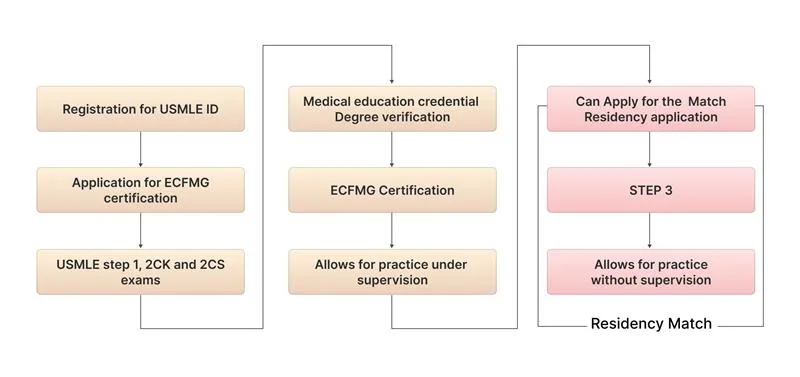
USMLE Exam Success Roadmap
What Happens After USMLE?
You've passed the USMLE. What's the final step to practicing in the U.S.?
Clearing the exams opens the door to the USMLE Match process. You will apply for positions through the ERAS (Electronic Residency Application Service) and enter the NRMP (National Resident Matching Program), which pairs candidates with residency programs.
Securing a USMLE residency position is the goal. For IMGs, this leads to excellent USMLE career options, including practicing as a licensed physician in the U.S., pursuing fellowships, or engaging in research, with a strong potential for professional growth and stability. Since June 2026, FSMB also sends USMLE transcripts to ERAS: how USMLE transcripts reach ERAS.
IMG Residency Match Rate in 2026
The 2026 NRMP Main Residency Match placed 9,682 IMGs in first-year jobs. The rate looks different for US citizen IMGs and non-US citizen IMGs.
Hold an Indian degree and no US citizenship? You fall in the non-US IMG group. Know your group before you plan. It shapes how hard the road looks and how many programs you should target.
2026 USMLE Residency Match Results
| IMG Category |
Active Applicants |
Matched to PGY-1 |
Match Rate |
| US Citizen IMGs |
4,210 |
2,949 |
70.0% |
| Non-US Citizen IMGs |
11,944 |
6,733 |
56.4% |
These figures show why it is important to understand your IMG category before planning your US residency application. Source: NRMP, 2026 Main Residency Match.
If you graduated from an Indian medical college and are not a US citizen, you generally fall under the Non-US IMG category.
What Do These Match Rates Mean for Indian Medical Graduates?
A pass on the USMLE does not buy you a residency position. Programs read your whole file. They look at:
- Your Step 2 CK score and number of attempts
- Your school record and graduation year
- US clinical experience and letters of recommendation
- Research and other academic work
- Your interview
- Visa sponsorship needs
IMGs often aim for Internal Medicine, Family Medicine, Pediatrics, and Psychiatry. Each field picks its residents in its own way. Competition changes from one program to the next.
A strong Step 2 CK score helps. It still guarantees nothing.
The USMLE 7-Year Rule
The seven-year rule is an ECFMG limit. You get seven years to finish the exams needed for certification. The clock starts on the day you first pass a USMLE Step.
Here is how it works:
- You must pass Step 1 and Step 2 CK inside the seven years.
- On a Pathway, ECFMG must also accept your Pathways application in that window.
- Run out of time, and an older passing result may stop counting toward ECFMG Certification.
- Step 3 is not part of this ECFMG rule.
Does the Rule Cover Every Step?
No. ECFMG applies it to its certification exams. That means Step 1, Step 2 CK, and the clinical skills and communication requirements.
State medical boards run their own clocks. Some set a time limit for passing all three Steps before they grant a medical license. Look up the rules in the state where you want to work. Do this before you pick a date for Step 3.
US Clinical Experience for IMGs
You do not need US clinical experience (USCE) to take the exams. It still matters for the Match. Some programs demand it. Others count it as a bonus. Read each program’s page before you book a rotation.
Two types exist:
Observership
You watch doctors work. You learn how US hospitals run, but you do not treat patients.
Hands-on clinical rotation
You join supervised training, within the hospital’s rules and your role. You may also meet doctors who can write US letters of recommendation.
Good experience helps you understand American patient care. It also prepares you for interviews. It cannot promise a Match or a letter.
Career Paths after USMLE and Residency
Passing the exams is one piece. You also finish residency training and meet the licensing rules of your state.
Then doors open:
- Hospital practice: Practice as a Licensed Physician at a hospital in the USA.
- Private practice: Develop a career in a clinic or a private practice.
- Fellowship training: Deepen study of a subspecialty.
- Medical research: Practical research into medicine and the development of new treatments.
- Academic medicine: Teach students and do research at a medical school.
Resident Salary
Residents earn a paycheck while they train. Pay depends on the hospital, the city, your specialty, and your year. Each program lists its salary and benefits on its website. Read those pages before you apply.
A US medical license covers the US only. Other countries run their own registration and licensing systems.
Conclusion- Mastering the USMLE: A Path to Success
USMLE is an extensive examination that is strenuous and very crucial in the medical field. Success in the exams requires you to understand its structure and develop effective strategies.
What is the Key to Success?
- Early practice: You need to practice early to have a strong foundation for the USMLE test.
- Disciplined Process: Be focused on the methods of preparation.
- Effective resources: Use effective study resources and practice questions. Use MOKSH Academy's mentor-led Step 1 and Step 2 CK programs.
Believe in your abilities, stay motivated, and you will be on your way to success. Select MOKSH Academy as your partner in the USMLE Prep.
Disclaimer
USMLE® is a joint program. The Federation of State Medical Boards (FSMB) and the National Board of Medical Examiners (NBME) are co-sponsors. None of the trademark holders are affiliated with MOKSH Academy or this website.
ACGME® is a registered trademark of the Accreditation Council for Graduate Medical Education.
The ECFMG® is a registered trademark of the Educational Commission for Foreign Medical Graduates.
The Match® is a registered National Resident Matching Program® (NRMP®) service mark. The NRMP has no affiliation with MOKSH Academy.
Electronic Residency Application Service (ERAS®) is an Association of American Medical Colleges program. It has no affiliation with MOKSH Academy.
Test names and other trademarks are the property of the respective trademark holders. None of the trademark holders are affiliated with MOKSH Academy or this website.

 4.6
326 reviews