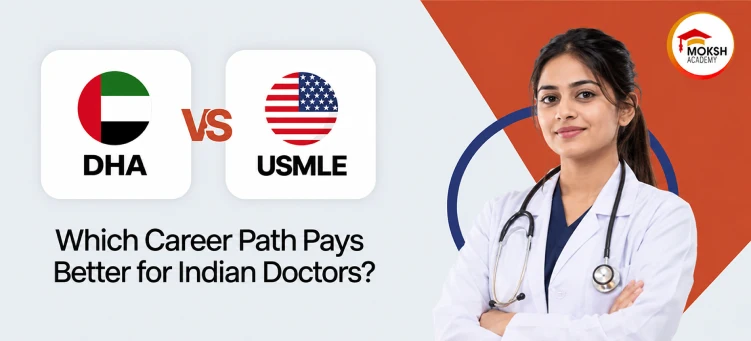
DHA gets you paid in 3 to 6 months. USMLE is a process that takes 4-7 years (or more). So that's the fundamental compromise between these two options for Indian doctors in 2026.
A DHA license lets you start earning a tax-free salary in Dubai fast, but your income has a ceiling. The USMLE pathway costs more, takes years longer and carries real risk of not matching into a US residency. But if you clear it, your peak salary can run into crores per year. Choose DHA if you want speed and certainty. Choose USMLE if you want the highest possible ceiling and can wait for it.
DHA vs USMLE: Quick Comparison Table
| Factor |
DHA (Dubai) |
USMLE (USA) |
| Time to first paycheck |
3-6 months |
4-7+ years |
| Total upfront cost |
Rs.68,000-Rs.1,25,000 |
Rs.15-25 lakh+ |
| Entry salary |
Rs.3.3-7.7L/month (GP), tax-free |
Rs.4.3-5L/month (residency stipend) |
| Peak salary |
Rs.11-22L+/month (Consultant), tax-free |
Rs.1.7-4.5 crore+/year (Attending) |
| Entry risk |
Exam pass + exemptions available |
IMG Match rate 54-56% |
| Path structure |
One exam cycle |
Multi-stage: Step 1, Step 2 CK, Match, residency, Step 3 |
The numbers tell a simple story.
DHA rewards speed. USMLE rewards patience and only if the Match works in your favor.
The DHA Path: What Indian Doctors Actually Earn and When
How Long Does DHA Licensing Take?
The DHA licensing process runs faster than almost any other international medical pathway. You register on Sheryan, complete DataFlow verification (this checks your degree and work history), then sit the Prometric-based DHA exam. Most doctors finish this in 3 to 6 months.
Some doctors skip the exam altogether. If you hold USMLE Step 3 or board certification from a recognized body, DHA may grant a DHA exam exemption. That shaves months off your timeline.
What Does a DHA-Licensed Doctor Earn?
Pay depends on your title and DHA sorts every applicant into one of three tiers:
- General Practitioner (GP): AED 15,000-35,000/month (Rs.3.3-7.7L), tax-free
- Specialist: AED 30,000-60,000/month (Rs.6.6-13.2L), tax-free
- Consultant: AED 50,000-1,00,000+/month (Rs.11-22L+), tax-free
None of this gets taxed. That single fact changes the math more than people expect. A GP in Dubai often takes home more real income than an MD in a private Indian hospital, even before you count the Consultant tier.
Doctors who already hold a specialist qualification or fellowship reach the Consultant bracket fastest. A fresh MBBS graduate with no postgraduate degree will start at GP level and climb from there.
The USMLE Path: What Indian Doctors Actually Earn and When
How Long Does the USMLE Pathway Take?
This path has more steps and each one takes time. You clear USMLE Step 1, then Step 2 CK, then apply through ECFMG for certification. After that comes the hardest part: the residency Match. If you match, residency itself runs 3 to 7 years depending on your specialty. USMLE Step 3 usually happens during residency, not before it.
Add it up and you get a 4 to 7 year runway before you see attending-level pay. For competitive specialties, it can stretch longer.
What Does a US-Licensed Doctor Earn?
Pay comes in two very different stages:
-
During residency: $5,000-5,800/month (Rs.4.3-5L), the same for every resident regardless of nationality
-
After residency, as an Attending: $150,000-575,000+/year (Rs.1.7-4.5 crore+), depending on specialty
The gap between these two numbers is the whole reason people take on the USMLE grind. Ten years post-MBBS, a US attending often earns 8 to 15 times what a specialist earns in India.
What Is the Real Risk?
Here is what most guides skip. The USMLE Match rate for non-US IMGs sits around 54 to 56 percent in 2026. That means close to half of international applicants who clear all three Steps still do not match into a residency on their first attempt. You can spend Rs.15-25 lakh and years of study and still face a Match cycle with no guarantee.
This is not a reason to avoid USMLE. It is a reason to walk in with clear eyes about the odds. And to boost your chances of Match, you will need mentorship based guidance from MOKSH Academy.
Which Path Should You Choose?
Your answer depends less on money and more on where you are in your career right now.
Choose DHA if:
- You want to start earning within a year, not a decade
- You already hold a license or PG degree and want a practical, immediate move
- Tax-free income today matters more to you than a distant, higher ceiling
- You would rather avoid the uncertainty of a competitive Match process
Choose USMLE if:
- You are early in your career, post-MBBS or early into a PG program, with years to spare
- You want full US residency training, not just a clinical job
- You can absorb Rs.15-25 lakh in cost with no guaranteed return
- The size of your peak salary matters more to you than how soon it arrives
Both choices are rational. A doctor supporting a family right now needs different things than a 24-year-old with a decade of runway. The data above should tell you which version of yourself you are planning for.
Can You Pursue Both?
Yes and the two paths are not mutually exclusive. A DHA license does not block you from attempting USMLE later. Many doctors work in Dubai first, save money, then use that income to fund USMLE prep without the financial pressure of studying and earning nothing at the same time.
The reverse also works. If you already hold USMLE Step 3, that credential can qualify you for a DHA exam exemption, fast-tracking your Dubai license if your plans ever shift toward the Gulf instead.