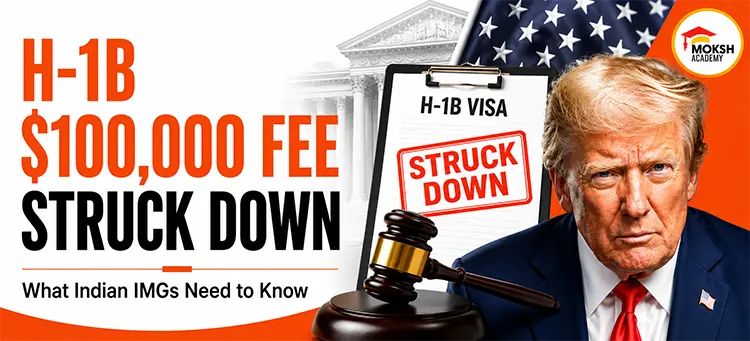
On June 8, 2026, federal judge Leo Sorokin ruled the H-1B $100,000 fee was an unlawful tax - and struck it down. Indian medical graduates are at the center of this story. They hold nearly 70% of all H-1B approvals, and one in four practicing doctors in the US is an international medical graduate. But the fight is not over. An appeal has already been filed, and three separate lawsuits are active across three federal circuits.
What Did the Federal Judge Actually Rule on the H-1B $100,000 Fee?
On September 19, 2025, President Trump signed Proclamation 10973. It added a $100,000 fee to every new H-1B petition. Before this, employers paid between $2,000 and $5,000 depending on the petition type.
Judge Leo Sorokin in Boston found the fee was not a regulatory penalty. It was a tax. And Congress never authorized it. That made it a direct violation of the Administrative Procedure Act and an overreach of executive authority on H-1B policy.
Twenty Democratic states, led by California and Massachusetts, brought the lawsuit. This ruling contradicts a December 2025 DC court decision that had upheld the same fee in the US Chamber of Commerce case. Two federal judges. Two opposite outcomes. That conflict matters - and we will come back to it.
Why Does This Ruling Matter More for Indian Doctors Than Anyone Else?
This is not a general immigration story. The numbers make it specific.
| Group |
Share of H-1B Program |
Impact of the $100,000 Fee |
| Indian nationals |
70% of all H-1B approvals |
Disproportionate financial burden on sponsoring employers |
| IMGs in the US physician workforce |
1 in 4 practicing doctors |
Threatened pipeline into residency and fellowship |
| Internal medicine resident interns (IMGs) |
Nearly 40% |
Hospitals already operate on tight margins |
| Family doctors who are IMGs |
More than 1 in 5 |
Concentrated in rural and underserved areas |
Dr. Bobby Mukkamala, AMA President and the first physician of Indian heritage to lead the organization, said it plainly. His own parents were IMGs who moved to Flint, Michigan. A $100,000 fee would have made that impossible. With the fee in place, patients wait longer and drive farther for care.
That is not a small concern. Nearly 87 million Americans live in healthcare shortage regions. The Indian IMG physician pipeline is not supplemental to US healthcare. In many communities, it is the healthcare.
What Does the Ruling Change Right Now for Indian Medical Graduates?
If You Are Applying for Residency or Fellowship
Hospitals can now sponsor H-1B petitions without the $100,000 barrier. Programs that reduced IMG intake after September 2025 may reopen slots. The J-1 to H-1B conversion pathway - a common route for doctors finishing residency - is no longer financially blocked for sponsoring hospitals. If your program delayed action, follow up now.
If You Are Preparing for USMLE and Planning to Match
This ruling removes the single largest structural threat to IMG-friendly residency programs. Cap-exempt H-1B positions at hospitals, universities, and nonprofits were less affected by the fee to begin with. But the ruling strengthens the entire pathway. Do not pause USMLE prep or your match strategy. The window to act is open today.
If You or Your Employer Already Paid the $100,000 Fee
More than 200,000 applicants paid under the fee structure. As of June 8, 2026, the Department of Homeland Security has not issued any H-1B refund 2026 guidance. Do not assume a refund is automatic. Document every payment and consult an immigration attorney before taking any steps.
Ready to build your USMLE and residency strategy?
Is the H-1B Fee Really Gone, or Could It Come Back?
This is the question most articles are not answering. Here is the honest picture.
The White House has already stated it "is confident this order will be reversed on appeal." The Trump H-1B executive order appeal is filed and active.
Three simultaneous cases are now running in three federal circuits - Boston, Washington DC, and San Francisco. The DC court previously upheld the fee. The Boston court just struck it down. That direct contradiction between circuits makes a Supreme Court referral not just possible - it is likely if the administration keeps pushing.
There is one other factor. The $100,000 fee is currently scheduled to expire naturally in September 2026. The appeal timeline may actually outlast the policy itself. That does not mean the threat disappears. Even without this specific fee, the administration can pursue other procedural restrictions on H-1B visa holders that fall outside the scope of this ruling.
The fee is blocked today. It is not permanently dead.
What Should Indian Medical Graduates Do Right Now?
- Do not pause H-1B petition planning - the ruling is in effect today
- If your sponsoring hospital delayed your application because of the fee, follow up immediately
- J-1 holders considering H-1B conversion should move forward but monitor the First Circuit and DC Circuit for appeal developments
- If you or your employer paid the $100,000 fee, document everything and wait for DHS refund guidance
- Do not make any visa pathway decisions without speaking to a board-certified immigration attorney for IMG physicians
- Track both the Boston and DC appellate courts - conflicting rulings could reach the Supreme Court before September 2026
Unsure how this affects your residency plans?
What is the H-1B visa? A non-immigrant work visa that allows US hospitals, universities, and clinics to hire foreign professionals in specialty occupations for up to six years.