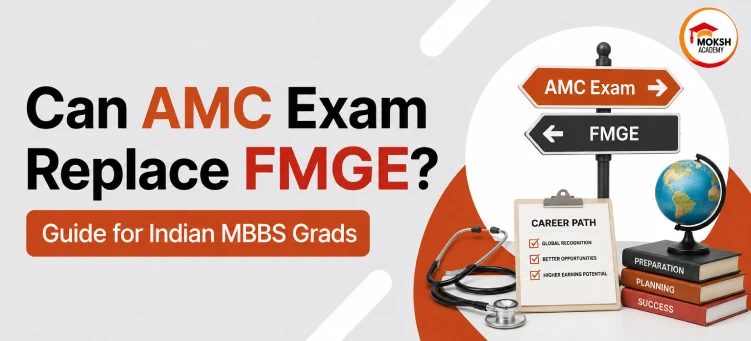
This question can arise for many doctors who are still planning to study ahead. And YES, the AMC exam can work as an alternative path for Indian MBBS graduates, but it does not replace FMGE in a literal sense. FMGE gives you a license to practice in India. The AMC exam gives you a license to practice in Australia through AHPRA registration. If you keep failing FMGE, you are not stuck. You can choose Australia instead of India and build a full medical career there. The two exams test similar medical knowledge, but they lead to different countries, different systems, and different outcomes. This guide breaks down exactly when AMC makes sense, what your FMGE prep is worth, and what the switch actually costs.
FMGE vs AMC: What Each Exam Actually Licenses You For
FMGE, run by the National Board of Examinations, screens Indian and OCI citizens who earned their MBBS abroad. Pass it, and you can register to practice medicine in India. That is its only job.
The AMC exam works differently. It checks whether international medical graduates meet the standard needed for AHPRA registration in Australia. Passing AMC does not touch your Indian registration status at all. It opens a door in a different country.
Here is the part most students miss. These are not two exams competing for the same prize. One is a ticket to India. The other is a ticket to Australia. Mixing them up leads to bad decisions.
Why Indian Graduates Are Looking at AMC Right Now
FMGE pass rates have stayed low for years. Recent data shows pass rates as low as 12% to 20%, depending on the session. Thousands of graduates sit for the exam twice a year, and most walk away without a pass.
Here's the fact many blogs get wrong: FMGE currently has no cap on the number of attempts. A proposal in 2023 suggested limiting candidates to six attempts within three years, but as of 2026, that rule has not taken effect. You can still retake FMGE as many times as you need.
AMC also has no attempt limit. But it gives you something FMGE does not: a clear, staged path. You take the MCQ exam, then the clinical exam, then move toward registration. Each stage has a defined outcome, so you always know where you stand.
If FMGE has worn you down, this matters. You are not locked into endless retakes with no plan B.
FMGE vs AMC: Side-by-Side Comparison
The numbers tell the story faster than paragraphs can. Here is how the two exams stack up.
| Category |
FMGE |
AMC (Standard Pathway) |
| Governing Body |
National Board of Examinations (NBE) |
Australian Medical Council |
| Country of Practice |
India |
Australia |
| Exam Structure |
Single-step (MCQ only) |
Two-step (MCQ + Clinical Exam ) |
| Number of Questions/Stations |
300 MCQs |
150 MCQs (Part 1), 16 stations (Part 2) |
| Duration |
5 hours |
3.5 hours (Part 1), 8 hours (Part 2) |
| Passing Criteria |
50% or higher |
Score-based ability measure (Part 1), 10+ of 14 assessed stations (Part 2) |
| Attempt Limit |
No limit currently |
No limit |
| Approx. Cost |
Roughly Rs.6,195 per attempt |
AUD $5,920 for MCQ + in-person clinical exam, excluding portfolio/verification and other costs |
| Result Validity |
Lifetime once passed |
Time-bound; check current AMC rules before applying |
What Actually Carries Over From FMGE Prep to AMC
Your FMGE study hours are not wasted, but they will not carry you the whole way either.
What transfers well:
- Basic sciences: anatomy, physiology, pathology, and pharmacology show up in both exams
- Core clinical subjects: medicine, surgery, obstetrics and gynecology, and pediatrics overlap heavily
What does not transfer:
- Australian clinical guidelines, which differ from Indian protocols in dosing, referral pathways, and treatment sequencing
- The question style itself. FMGE uses direct single-best-answer questions. AMC's MCQ exam leans on longer, context-rich clinical scenarios that test judgment, not just recall
- Clinical communication skills, assessed directly in the AMC Clinical exam through simulated patient stations. FMGE has no equivalent component
A fair estimate: your FMGE foundation covers maybe 40% to 50% of what AMC demands. The rest is new territory, especially the clinical reasoning and communication piece.
Who Should Actually Consider Switching to AMC
This decision depends on your situation, not just your exam scores. Here is how to think about it honestly.
AMC could be a good fit if you:
- Have attempted FMGE multiple times without progress and are open to relocating
- Hold a recognized medical degree and have finished your internship
- Can clear an English proficiency exam like IELTS or OET
- Have the budget for AUD 6,290-plus in exam fees, plus relocation and living costs
- Value long-term career growth, stronger pay, and better work-life balance over staying in India at any cost
AMC is not the right move yet if you:
- Have not completed your rotatory internship. This is a hard requirement for AMC eligibility, and skipping it disqualifies your application entirely
- Feel strongly tied to practicing specifically in India, whether for family, culture, or long-term plans
- Are not financially ready for Australia's cost of living on top of exam fees
- Have not started on English proficiency testing and are not ready to invest time and money there separately
Neither path is automatically better. The right choice depends on your eligibility, your finances, and where you actually want to build your career.
Realistic Cost and Timeline to AMC Registration
Numbers help more than vague promises here. Below is what the path from zero to full AHPRA registration typically looks like.
| Stage |
Estimated Cost (AUD) |
Typical Timeline |
| AMC Portfolio + Primary Source Verification |
$642+ |
1-3 months |
| AMC CAT MCQ Exam |
$2,920 |
3-6 months |
| Clinical Exam / WBA |
$3,000-$3,400 / $1,070 WBA |
6-18+ months |
| Registration + Supervised Practice |
Additional fees |
12 months+ |
| Total Journey |
$6,562+ before registration/living costs* |
2-4 years |
That final number matters most. Most candidates need two to three years from the start of AMC prep to full registration, once you factor in supervised practice requirements and visa processing. This is not a fast track. It is a structured one.