What is the USMLE?
For a medical license in the US, candidates must pass the three-part US Medical Licensing Examination (USMLE).
The USMLE evaluates a doctor's use of clinical scientific knowledge, clinical skills, and medical knowledge that are necessary for practicing medicine. It is necessary for M.D. graduates to get medical licensure in the United States, which is granted by both domestic and foreign medical schools.
You've finished your MBBS. Now, what's the master key that can unlock a world-class medical career?
For Indian medical graduates aiming to practice in the United States, the USMLE exam overview is essential. It's not just another test; it's the definitive medical licensing exam USA pathway and the global gold standard. Unlike national entrance exams for specialty training, the USMLE is a comprehensive licensing series. It validates your complete readiness for safe, independent medical practice within the rigorous US healthcare system.
This clear USMLE career scope - leading to residency and beyond- is why so many Indian MBBS students choose the USMLE after MBBS over other international options. It provides a structured, merit-based route to unparalleled global opportunities.
Who Conducts USMLE & How the Exam Is Structured
The Authorities Behind the Exam
You can trust the USMLE exam authority. It isn't run by a single company — instead, two bodies are responsible for administering the United States Medical Licensing Examination (USMLE): the National Board of Medical Examiners (NBME) and the Federation of State Medical Boards (FSMB). Such dual regulation of NBME USMLE and FSMB USMLE means that the exam is standardized and strictly administered.
A Standardized, Computer-Based Test
The USMLE exam system is a standardized and computer-based format. This implies that all the candidates are tested under the same testing conditions and question formats. You will take it at a secure Prometric test center, ensuring a consistent and secure experience no matter where you are in the world.
USMLE Test Structure and Steps
| Steps |
About Exam |
| USMLE Step 1 |
8-hour test with a maximum of 280 questions broken up into 14 blocks of 30 minutes (20 questions each, 280 total). It is now a pass/fail exam. |
| USMLE Step 2 CK |
9-hour exam, 16 blocks of 30 minutes (18–20 questions each), 316 questions total (maximum), effective May 7, 2026. |
| USMLE Step 3 |
Two-day exam, with :
- Day 1 (FIP) has 12 blocks of 18-20 multiple-choice questions (MCQs) in 7 hours. 232 total questions.
- Day 2 (ACM) includes 9 blocks of 20 MCQs and 13-14 CCS cases in 9 hours. 180 total questions.
|
USMLE Step 1 Exam
Think of USMLE Step 1 as testing the core science behind medicine. The USMLE Step 1 examinations cover the understanding of the fundamentals of medical sciences such as pathology, pharmacology and anatomy.
- What It Tests: It tests your level of understanding on how to make use of the basic knowledge to diagnose and know how diseases develop.
- Subject Focus: The exam has a systems-based focus in that an integrated approach is being tested and you have to relate concepts across disciplines.
- Why It Still Matters: As of January 26, 2022, the USMLE Step 1 exam officially transitioned to a pass/fail system, replacing the previous three-digit numerical score. Despite this fact, there can be no compromise in this area. It plays a vital role in addressing the clinical cases at the subsequent stages and is also closely checked by the directors of residency programs to recognize any gaps in core knowledge.
USMLE Step 2 CK Exam
This step shifts from theory to practice. The USMLE Step 2 CK syllabus centers on clinical knowledge and patient care.
- Skills Tested: It assesses your clinical reasoning and decision-making skills. You will respond to questions that are in the format of realistic patient-based scenarios, diagnosing conditions and opting for the most appropriate next course of action in treatment.
- Residency Weight: This is the scored exam that is weighed the most heavily in your residency application. A strong USMLE Step 2 CK score directly demonstrates your readiness for the clinical responsibilities of a U.S. residency.
USMLE Step 3 Exam
The USMLE Step 3 exam is the final assessment of your ability to practice medicine without supervision.
- Licensing Purpose: Passing this step is mandatory to obtain an independent medical license in the United States.
- Different Format: One of the main elements is advanced clinical case simulations (CCS). You will manage virtual patients in real-time, making diagnoses and treatment decisions that affect their outcome.
- Timing: Most international medical graduates take this exam during the first year of their U.S. residency, using their hands-on clinical experience to their advantage.
What Are the USMLE Exam Dates and Eligibility Periods in 2026?
USMLE Eligibility for Indian Students & IMGs
If you are an International Medical Graduate (IMG), meaning you graduated from a medical school outside the US, you are on the right path. For Indian MBBS students, confirming your USMLE eligibility is the first critical step.
Your medical college must be listed in the World Directory of Medical Schools. Then, you must obtain ECFMG certification, which is your official credential verification to enter the USMLE system. A key requirement for this certification is completing 12 months of medical internship from a recognized institution, which is typically part of your MBBS program in India.
Here is a quick checklist for Indian students:
| Criteria |
Requirement |
Applicable Stage |
| Medical School |
Listed in World Directory of Medical Schools |
Before applying |
| ECFMG Certification |
Mandatory for all IMG USMLE candidates |
Before Step 1 & 2 CK |
| Medical Internship |
12 months completed |
For ECFMG Certification |
USMLE Exam Dates
The USMLE exam does not have fixed test dates. You pick a 3-month window when you want to test. Once your application is approved, you receive a USMLE scheduling permit. You then book your seat directly on the Prometric website. Permits are not released more than six months before your chosen eligibility period starts.
Starting January 2026, there is an important change for international graduates. USMLE services for IMGs have moved from ECFMG and MyIntealth to a new portal managed by FSMB. All new applications now go through the FSMB portal. If you are applying in 2026, make sure you register on the correct platform.
If you need more time, an eligibility period extension costs $100 per step for Step 1 and Step 2 CK.
Action steps before exam day:
- Register through the FSMB portal (not ECFMG's old system) for all 2026 applications
- Wait for your scheduling permit before booking on Prometric
- Book your seat the same day you receive the permit
- Avoid summer windows if possible - Prometric slots in Indian cities fill up fast, especially from May through August
What Is the USMLE Syllabus for Step 1 and Step 2 CK?
The USMLE syllabus does not test memorization. Every question is a clinical vignette. You read a patient case and pick the best answer. The exam tests how you think, not what you can recall.
There is a major format change for Step 1 starting May 14, 2026. The old 7-block format is gone. The new format has 14 blocks of 30 minutes each, with 20 questions per block. Plan your stamina and timing practice around this new structure.
USMLE Step 1 Topics
Basic Science Disciplines (high-yield for USMLE Step 1 topics):
- Pathology - highest-yield subject; covers every organ system
- Pharmacology - drug mechanisms, side effects, contraindications
- Physiology - cardiovascular, renal, and respiratory pathophysiology
- Microbiology - bacteriology, virology, antimicrobial therapy
- Biochemistry - metabolic pathways, enzyme defects, genetic disorders
- Immunology - autoimmune conditions, immunodeficiencies, hypersensitivity reactions
- Embryology - congenital anomalies and developmental milestones
Organ Systems (percentage weight on exam):
- Cardiovascular - 12 to 16%
- Respiratory and Renal - 11 to 15%
- Reproductive and Endocrine - 10 to 14%
- Gastrointestinal - 8 to 10%
- Musculoskeletal and Dermatology
- Behavioral Science, Biostatistics and Ethics
USMLE Step 2 CK Topics
Step 2 CK focuses on clinical management by organ system:
- Internal Medicine - ACS, heart failure, arrhythmias, hypertensive emergencies
- Pulmonology - pneumonia, pulmonary embolism, COPD and asthma exacerbations
- Neurology - stroke, seizures, altered mental status, headache syndromes
- Obstetrics and Gynecology - prenatal care, labor complications, contraception
- Pediatrics - developmental milestones, vaccines, common childhood illnesses
- Psychiatry and Substance Use - depression, psychosis, pharmacotherapy
- Surgery and Emergency Medicine - acute abdomen, trauma, shock management
- Preventive Medicine, Biostatistics, and Medical Ethics
How Does USMLE Compare to NEET PG and PLAB for Indian Doctors?
The right exam depends on where you want to practice. The US Medical Licensing Examination opens the door to America, PLAB opens the UK NHS, and NEET PG keeps you in India. Each has a different cost, timeline and career ceiling.
| Parameter |
USMLE (USA) |
PLAB (UK) |
NEET PG (India) |
| Conducting Body |
NBME + FSMB |
GMC (UK) |
NBE (India) |
| Number of Steps/Parts |
3 Steps |
2 Parts |
1 Exam |
| Exam Type |
Clinical vignette MCQ + CCS |
MCQ + OSCE |
MCQ only |
| Total Fees (approx.) |
$3,000-$4,000 USD |
£800-£1,500 GBP |
Rs. 4,000-6,000 |
| Timeline to Practice |
4-6 years (incl. residency) |
2-3 years |
3-5 years (PG + residency) |
| Residency Stipend |
$60,000-$80,000/year |
£30,000-£40,000/year |
Rs. 50,000-1,00,000/month |
| Global Recognition |
Highest |
High (UK/Commonwealth) |
India only |
| Attempts Allowed |
4 per Step |
Unlimited |
3 attempts |
| Destination |
USA |
UK + Commonwealth |
India |
USMLE Exam Fees
Apply for the USMLE Examination Step 1
For Graduates of LCME or COCA-accredited medical programs in the US. Apply through ECFMG.
Cost of USMLE exam (students outside the US)
| Exam |
Base Fee (USD) |
International Surcharge (USD) |
Total Before GST (USD) |
18% GST (USD) |
Final Amount (USD) |
Final Amount (INR approx.) |
| Step 1 |
$695 |
$210 |
$905 |
$163 |
$1,068 |
Rs.89,700 |
| Step 2 CK |
$695 |
$235 |
$930 |
$167 |
$1,097 |
Rs.92,100 |
| Step 3 |
$955 |
None (US only) |
- |
- |
$955 |
Travel required |
$1 = Rs. 84
- ECFMG Certification (required for IMGs pursuing U.S. residency eligibility): $580
- Extension of Eligibility Period (Step 1/Step 2 CK only): $100 per exam.
- Step 1/Step 2 CK Testing Region Change: $90 per region change.
- Step 1/Step 2 CK Rescheduling Fee: Varies (depends on exam, testing region, and date of cancellation)
- Score Recheck (Step 1/Step 2 CK): $80 per exam.
Beyond the USMLE Examination Fees: Smart Financial Planning
The official USMLE exam fees are just one part of the total investment. Smart financial planning involves planning the entire USMLE budget, including some of the key hidden costs.
In estimating your total cost with regard to your USMLE exams, you should also include the following costs:
| Expense Type |
Estimated Cost (USD) |
Notes |
| Exam Fees (Step 1, 2 CK, 3) |
$3,120 |
Official registration costs. |
| Study Resources & Qbanks |
$1,000 - $2,500 |
High-quality question banks and review materials are vital. |
| Travel & Accommodation |
$1,000+ |
For test centers or clinical rotations, if required. |
| Visa & Application Fees |
Variable |
Costs for residency applications (ERAS, interviews). |
Although noteworthy, this investment can provide a good long-term payoff as opposed to other postgraduate options. It launches a career in the global medical field.
Where Can Indian Students Take the USMLE?
Indian students can take the USMLE Steps 1 and 2 CK at Prometric test centers in India. You do not need to travel abroad for these two exams at first.
The major testing cities include:
- Ahmedabad
- Allahabad
- Bangalore
- Chennai
- Gurgaon (New Delhi NCR)
- Hyderabad
- Kolkata
- Mumbai
- Trivandrum
Here is a simple breakdown of the test locations:
- For Steps 1 & 2 CK: You book a seat at a Prometric test center in India.
- For Step 3: This exam is held only in the United States. You will take it after starting your US residency.
How Long Does It Take to Prepare for USMLE and Which Books Should You Use?
Most Indian MBBS students underestimate how long real USMLE preparation takes. Here is an honest timeline and the resources that actually work.
Recommended USMLE Study Timeline
| Phase |
Step |
Recommended Duration |
Activity |
| Foundation |
Step 1 |
6-12 months |
Concepts + First Aid + Pathoma |
| Dedicated Prep |
Step 1 |
4-8 weeks full-time |
UWorld + NBME practice forms |
| Clinical Phase |
Step 2 CK |
6-8 months during/after rotations |
UWorld + OnlineMedEd |
| Dedicated Prep |
Step 2 CK |
6-8 weeks full-time |
Timed blocks + NBMEs |
| Residency Year |
Step 3 |
During PGY-1 |
UWorld Step 3 + CCS cases |
Recommended USMLE Books and Resources
Step 1 Resources:
- First Aid for USMLE Step 1 (2026 edition) - the foundational framework every student builds on
- Pathoma by Dr. Hussain Sattar - the highest-yield pathology resource available
- UWorld Step 1 Qbank - non-negotiable; plan for two complete passes
- Sketchy Micro and Sketchy Pharm - excellent for visual learners
- NBME Practice Forms - mandatory for accurate score prediction
- MOKSH Academy - The MOKSH Academy Step 1 is designed to provide you with the plan and support you need. It has a mentor-managed roadmap, live classes and MOKSH Qbank. Your mentor has a clear NBME schedule and weekly check-ins.
Step 2 CK Resources:
- UWorld Step 2 CK Qbank - your primary resource; question-based learning from day one
- First Aid for USMLE Step 2 CK (2026 edition) - use it as an algorithm reference
- OnlineMedEd - video-based clinical reasoning supplement, strong for pattern recognition
- NBME Clinical Mastery Series and UWSAs - simulate real exam conditions
- MOKSH Academy coaching - Gain and benefit from our Personal Mentorship, Adaptive Learning Platform, Curated Qbank & Mock Tests and Custom Study Scheduler.
Key preparation principles every IMG should follow:
- Start UWorld from day one - do not wait until you have "finished reading" to begin questions
- Two passes of UWorld is the standard approach for 240+ scorers on Step 2 CK
- For USMLE preparation for Indian students, prep often runs parallel to final MBBS years or starts right after internship - both are valid; start earlier if you can
- USMLE coaching for Indian students adds structure, accountability, and peer learning - this matters most for IMGs who are preparing without a US medical school curriculum around them
Registration Process for USMLE exam
- Create an FSMB account.
- Submit your USMLE application through the FSMB portal.
- Complete identity verification and required eligibility documentation.
- Select your testing eligibility period.
- Receive your scheduling permit.
- Schedule your exam with Prometric.
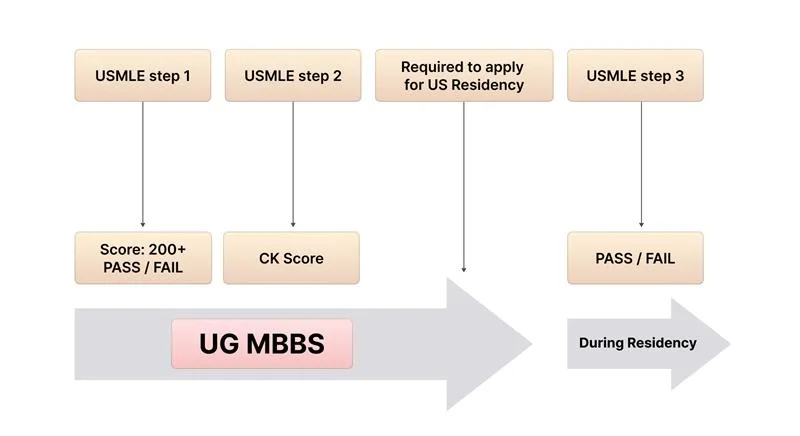
Sequential USMLE Journey Process
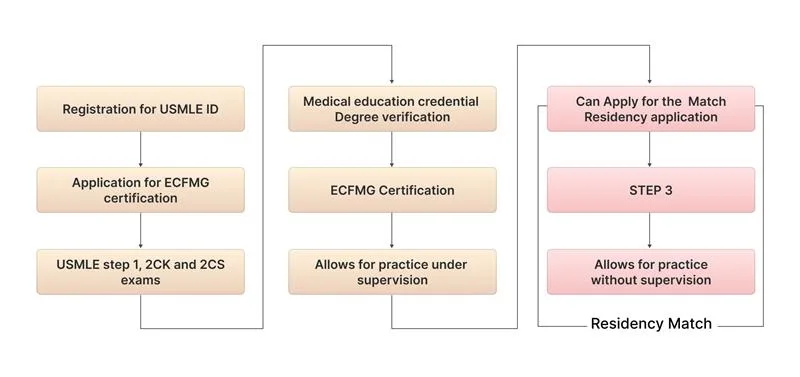
USMLE Exam Success Roadmap
What Happens After USMLE?
You've passed the USMLE. What's the final step to practicing in the U.S.?
Clearing the exams opens the door to the USMLE Match process. You will apply for positions through the ERAS (Electronic Residency Application Service) and enter the NRMP (National Resident Matching Program), which pairs candidates with residency programs.
Securing a USMLE residency position is the goal. For IMGs, this leads to excellent USMLE career options, including practicing as a licensed physician in the U.S., pursuing fellowships, or engaging in research, with a strong potential for professional growth and stability.
In 2025, what was the Residency Match Rate for IMGs?
In the 2025 NRMP Main Residency Match, IMGs secured 9,761 first-year (PGY-1) residency positions. The overall match rate across all IMGs (US and non-US citizens combined) was 60.8%. For non-US citizen IMGs specifically — the group most Indian MBBS graduates fall into — the PGY-1 match rate was 58%.
Note- Data updated for the 2025 NRMP Main Residency Match.
The other factors following Step 1 pass are most important, namely Step 2 CK score and US clinical experience for IMGs. Here is how the top specialties performed for non-US IMGs:
| Specialty |
IMG Positions Filled (2025) |
Avg. Step 2 CK Score (Non-US IMG) |
| Internal Medicine |
4,718 |
248 |
| Family Medicine |
High volume |
- |
| Pediatrics |
High volume |
- |
| Psychiatry |
High volume |
- |
| Neurology |
Competitive |
246+ |
| Pathology |
Competitive |
240+ |
IMG-friendly specialties like Internal Medicine, Family Medicine, Pediatrics and Psychiatry continue to offer the best match odds. Surgical specialties remain highly competitive and strongly prefer USCE.
What Is the USMLE 7-Year Rule and How Long Do Scores Stay Valid?
Many Indian students delay steps due to internship or family reasons. Understanding the USMLE 7-year rule before you start is critical.
- The 7-year clock starts on the date you pass your first USMLE Step
- All three Steps must be passed within 7 years to qualify for ECFMG certification
- Your USMLE score validity does not expire, but ECFMG will not accept your earliest passing score for certification if the 7-year window has closed
- Most US state medical boards require all Steps completed within 7 years - some states allow 10 years, and a few have no limit; check your target state board before planning
- MD/PhD candidates may apply for a formal extension
Do USMLE IMGs Need US Clinical Experience to Match Into Residency?
You do not need US clinical experience to sit the USMLE Steps. But you almost certainly need it to match into residency - especially in competitive programs.
Here is what you need to know about USCE for USMLE IMGs:
- Most competitive residency programs either require or strongly prefer USCE on your application
- There are two types: observership (shadowing only, no patient contact) and hands-on clinical rotations (direct patient care, letter of recommendation eligible)
- Hands-on clinical rotations in the USA generate US letters of recommendation, which carry significant weight in your ERAS application
- IMGs with USCE match at meaningfully higher rates than those without - the gap is widest in non-primary care and specialty tracks
- Surgical specialties and competitive programs view USCE as close to non-negotiable
If you are an Indian MBBS graduate planning to apply in the next two to three years, securing structured hands-on placements in US hospitals with LoR support is one of the highest-leverage investments you can make. Moksha Academy's US Clinical Rotations program offers exactly this - structured rotations at US hospitals with letter of recommendation support built in.
Opportunities after Residency Match
- Gets a globalized license, i.e., Doctors can practise globally.
- PG Opportunities, i.e., MD, MS.
- Fellowships
- Private Practise
- Research Opportunities: R&D
- During residency, you can earn a stipend ranging from $60,000 to $70,000.
Conclusion- Mastering the USMLE: A Path to Success
USMLE is an extensive examination that is strenuous and very crucial in the medical field. Success in the exams requires you to understand its structure and develop effective strategies.
What is the Key to Success?
- Early practice: You need to practice early to have a strong foundation for the USMLE test.
- Disciplined Process: Be focused on the methods of preparation.
- Effective resources: Use effective study resources and practice questions. Select the whole study content of MOKSH Academy.
Believe in your abilities, stay motivated, and you will be on your way to success. Select MOKSH Academy as your partner in the USMLE Prep.
Disclaimer
USMLE® is a joint program. The Federation of State Medical Boards (FSMB) and the National Board of Medical Examiners (NBME) are co-sponsors. None of the trademark holders are affiliated with MOKSH Academy or this website.
ACGME® is a registered trademark of the Accreditation Council for Graduate Medical Education.
The ECFMG® is a registered trademark of the Educational Commission for Foreign Medical Graduates.
The Match® is a registered National Resident Matching Program® (NRMP®) service mark. The NRMP has no affiliation with MOKSH Academy.
Electronic Residency Application Service (ERAS®) is an Association of American Medical Colleges program. It has no affiliation with MOKSH Academy.
Test names and other trademarks are the property of the respective trademark holders. None of the trademark holders are affiliated with MOKSH Academy or this website.