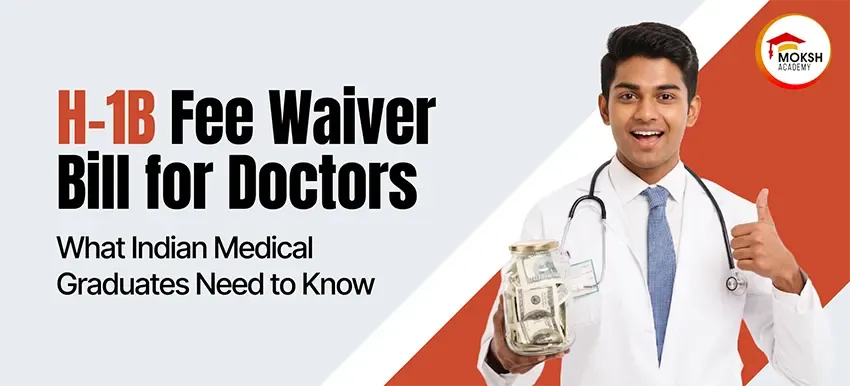
A new bill introduced in the US Congress on March 17, 2026, could remove a major financial barrier for foreign-trained doctors trying to work in America. If it passes, Indian medical graduates will no longer have to worry about a $100,000 visa fee standing between them and a US medical career.
Here is everything you need to know.
What Just Happened
Four US lawmakers - two Republicans and two Democrats - introduced the Physicians and Healthcare Workforce Act. The bill has one clear goal: exempt doctors and other healthcare workers from the $100,000 H-1B visa fee that the Trump administration imposed in September 2025.
Representatives Michael Lawler, Sanford Bishop Jr., Maria Elvira Salazar and Yvette Clarke are the sponsors. This is bipartisan.
Both parties agree the fee is hurting American healthcare.
Where Did the $100,000 Fee Come From
In September 2025, the Trump administration issued a Presidential Proclamation requiring all new H-1B visa petitions filed after September 21, 2025, to include a $100,000 fee.
This is not a fine. It is a mandatory filing fee that the sponsoring hospital or clinic must pay to hire a foreign doctor.
Most hospitals, especially smaller ones and those in rural areas, simply cannot afford it.
Who Does the Fee Actually Affect
This matters a lot for Indian IMG doctors planning their US career. Here is a clear breakdown:
| Affected |
Not Affected |
| New H-1B petitions filed after Sept 21, 2025 |
H-1B holders already in the US renewing or extending |
| Indian IMGs seeking first-time US sponsorship |
J-1 visa holders currently in residency |
| Hospitals hiring new foreign-trained physicians |
Petitions approved before Sept 21, 2025 |
If you are still in India preparing for USMLE, this fee affects your future employer, not you directly. But if hospitals stop sponsoring H-1Bs because of the cost, your job offer disappears before it even arrives.
Why Indian Doctors Are Hit the Hardest
The numbers make this clear:
- Over 70% of all H-1B visas issued in the US go to Indian nationals
- Nearly 59,000 India-trained doctors are currently working in the US
- 1 in 5 immigrant doctors in the US is of Indian origin
- 25% of all practicing US physicians are international medical graduates (IMGs)
The US already has a serious doctor shortage. The AAMC projects a shortage of 86,000 physicians by 2036. The HRSA puts that number at 187,130 by 2037. Indian doctors have been quietly filling that gap for decades.
In rural counties, H-1B-sponsored physicians are nearly twice as common as in urban areas. Remove the pipeline and rural America loses doctors fast.
How This Disrupts Your USMLE-to-Residency Path
This is the section every Indian MBBS graduate targeting US residency needs to read carefully.
- 30% of US medical residents are international medical graduates
- 10,000 of the 43,000 annual residency slots are filled by H-1B visa holders
- A survey of New York hospitals found 25% had already paused or deferred H-1B hiring after the fee was announced
The J-1 to H-1B conversion route is the path most Indian IMGs follow after completing residency. You finish residency on a J-1 visa, get a J-1 waiver, then your employer sponsors your H-1B so you can stay and practice. That conversion now comes with a $100,000 price tag attached to it. Many smaller hospitals and community health centers are already saying no.
What the New Bill Proposes
The Physicians and Healthcare Workforce Act does two things:
- Fully exempts healthcare workers from the $100,000 H-1B fee.
- Blocks any future fees beyond what existing US immigration law already allows for healthcare workers.
The bill has strong backing from major medical organizations:
- American Medical Association (AMA)
- American Hospital Association (AHA)
- Association of American Medical Colleges (AAMC)
- Greater New York Hospital Association
- Physicians for American Healthcare Access
Current status: Introduced in the House. Not yet passed.
Legal Battles Already in Court
While Congress debates the bill, courts are already fighting over the fee:
- 20 Democratic-led states filed a lawsuit against the fee in December 2025.
- The US Chamber of Commerce filed a separate lawsuit; a federal appeals court agreed to fast-track it in January 2026.
- However, District Judge Beryl Howell already ruled in favor of the administration in the Chamber case.
The legal outcome could nullify the fee before the bill even passes. Both fronts are worth watching.
What Indian Medical Students Should Do Right Now
Do not pause your USMLE preparation. The demand for Indian IMGs in the US is not shrinking. It is growing. Here is what to do:
- Keep preparing for USMLE Steps 1, 2 CK, and 3. The physician shortage makes you more valuable, not less.
- Understand J-1 vs H-1B before you apply to residency programs. Know which route your target program uses.
- Ask program directors directly about their H-1B sponsorship policy before submitting your rank list.
- Track this bill and the court cases. A court stay or a passed bill could remove the fee entirely.
- Get ECFMG certified on time.Without it nothing in the pipeline works.
For Indian MBBS graduates preparing for USMLE, this bill is one to watch closely. The fee has created real uncertainty. But the underlying demand for Indian doctors in the US has not changed - and the bipartisan push to fix this problem shows that even lawmakers know it.