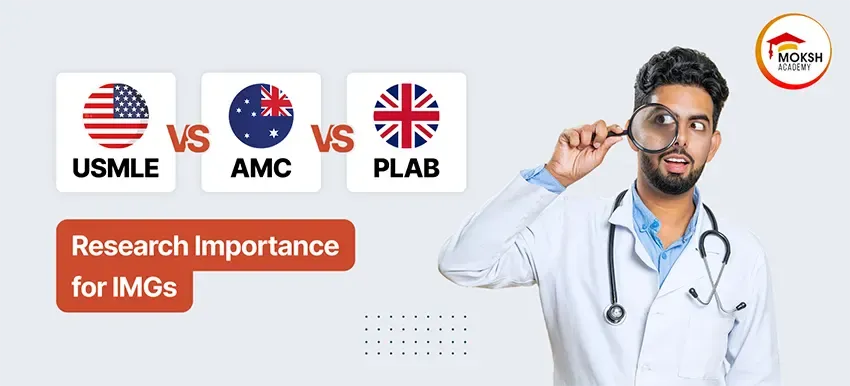
Confused about the need for research to pass USMLE, AMC, or PLAB? You are not alone.
Here is the short answer: research is not mandatory for any of these exams. But if you are targeting US residency match, it can make or break your application - especially after Step 1 became pass/fail.
This guide breaks down the real importance of research for IMGs across all three pathways. So you stop guessing and start planning smart.
Why this matters for you:
- Understand the actual PLAB research requirement (hint: there is none for licensing).
- Know when research for AMC and specialist training in Australia becomes relevant.
- Learn how research fits into your IMG residency application - and when to skip it entirely.
Is Research Mandatory for USMLE, AMC, or PLAB?
No. To sit any of these exams, research is not compulsory.
But that is only half the answer.
Here is what actually matters:
- USMLE - Research is not needed for the exam. But it is highly valuable for your US residency match, especially after Step 1 became pass/fail.
- AMC - No research needed for licensing. It becomes relevant only if you pursue specialist training in Australia.
- PLAB - No research required for GMC registration. It helps only for competitive NHS specialty training roles.
Bottom line: If you are just trying to get licensed, skip the research stress. If you want a competitive IMG residency application in the US, research matters - a lot.
Quick Reference: Is Research Mandatory?
| Exam |
Required for Exam? |
Required for License? |
Important for Career Progression? |
| USMLE |
No |
No |
Yes - Residency Match |
| AMC |
No |
No |
Sometimes - Specialist Training Australia |
| PLAB |
No |
No |
Sometimes - NHS Specialty Competition |
Why Research Matters More After USMLE Step 1 Became Pass/Fail
Before 2022, a high Step 1 score could open doors on its own.
That changed.
Now Step 1 is just pass or fail. Program directors can no longer use it to rank applicants. So they shifted to other filters.
Here is what they look at now:
- Step 2 CK score - this is the new differentiator
- USCE (US Clinical Experience) - hands-on exposure matters
- Research and publications - especially for competitive specialties like Dermatology, Orthopedics, and Neurosurgery
- Letters of recommendation - from US faculty if possible
NRMP data shows that program directors increasingly value scholarly activity when reviewing ERAS applications. For IMG residency applicants, a strong research background signals commitment and academic ability.
So is one year of research worth it?
Not always. A single first-author publication or a strong abstract can be enough. You do not need to spend a full year. Smart, focused research gives you ROI without killing your exam prep timeline.
USMLE vs AMC vs PLAB - Where Research Actually Impacts Your Career
Each pathway works differently. And that changes how much research matters.
Here is the simple breakdown:
- USMLE pathway leads to a US residency match. It is competitive. Research is a real differentiator.
- PLAB pathway leads to GMC registration and NHS job entry in the UK. It is a licensing exam first.
- AMC pathway leads to supervised practice in Australia. Licensing is the priority. Specialty comes later.
Which route places the greatest importance on research?
USMLE - by a significant margin.
In the US, you compete for limited residency spots. Program directors review your full profile. Research signals dedication. It fills the gap left by Step 1 pass/fail.
In the UK, the training number competition is real, but clinical skills and interview performance carry more weight than publications at entry level.
In Australia, the Australian specialist college pathway may expect research during training, not before it.
Research Impact by Career Stage
| Stage |
USMLE Pathway |
PLAB Pathway |
AMC Pathway |
| Exam Stage |
No impact |
No impact |
No impact |
| Initial Registration |
No |
No |
No |
| Residency / Specialty Training |
High impact |
Moderate |
Moderate |
| Academic Career |
High |
Moderate |
Moderate |
For most Indian IMGs, the decision is simple. If the US is your goal, invest in research early. If you are going the UK or Australia licensing route, focus on clinical prep first and research later - if at all.
Should Indian MBBS Students Do Research? (Decision Framework)
Not every student needs to do research. It depends on where you want to go and what you want to do there.
Ask yourself one question: What is my end goal?
Your answer changes everything.
Should You Invest in Research?
| Student Profile |
Target Country |
Research Priority |
Recommendation |
| Final year MBBS - competitive US specialty |
USA |
High |
Start a publishable project now |
| MBBS - non-competitive US specialty |
USA |
Medium |
Aim for at least 1 research output |
| PLAB - NHS job only |
UK |
Low |
Focus on clinical skills + PLAB prep |
| AMC - GP pathway |
Australia |
Low |
Prioritize clinical prep first |
| Planning academic medicine abroad |
Any |
High |
Build a structured research plan |
Short on Time Before Your Exam?
That is the most common worry. Here is the honest answer.
If your exam is within 3 months - do not start a new research project. Finish your prep first.
If you have 6 months or more - a case report or clinical audit can run in parallel without hurting your studies. These are low-effort, high-medical career ROI outputs.
Research for IMGs does not have to mean one full lost year. A focused 8-12 week project can produce something real for your ERAS application or CV.
The key is choosing the right project at the right time - not doing research for the sake of it.
What Type of Research Actually Matters?
Not all research carries the same weight. Spending six months on the wrong project is a real risk.
Here is what actually moves the needle.
Research Types Ranked by Impact
| Type |
Time Required |
Impact for USMLE |
Impact for PLAB / AMC |
| Case Report |
Low |
Moderate |
Low |
| Systematic Review |
Moderate |
High |
Moderate |
| Retrospective Study |
Moderate |
High |
Moderate |
| Prospective Trial |
High |
Very High |
Moderate |
| Clinical Audit/QI |
Low |
Moderate |
High(UK relevance) |
What should you actually pick?
- Targeting US residency? A retrospective study or systematic review published in a PubMed indexed journal gives you the best return for time spent.
- Targeting NHS roles? A clinical audit or quality improvement project is more relevant and faster to complete.
- Short on time? A case report with a conference abstract is a quick, credible CV line.
Will Indian publications count for US residency?
Yes - if they are credible.
Program directors care about two things: is it peer reviewed and is it relevant to your specialty? A well-executed study published in an indexed journal counts - regardless of whether it came from Mumbai or Minnesota.
Avoid predatory journals at all costs. They hurt more than they help.
Common Myths About Research and Foreign Medical Exams
These myths waste students' time. Let's clear them up fast.
Myth 1: There is an obligatory research in USMLE.
Fact: Attending USMLE exam tests has nothing to do with research. You can sit for all three Steps with no publication.
Myth 2: PLAB requires research.
Fact: GMC registration does not require research. PLAB tests clinical understanding - not academic work.
Myth 3: To apply for AMC you need research.
Fact: AMC eligibility rules are founded on your medical degree and clinical training - not publications.
Myth 4: Only US-based research counts for residency
Fact: The quality is not determined by geography. A well-executed study from an Indian institution, published in a peer reviewed indexed journal, carries real weight. IMG misconceptions like this one stop good candidates from even trying.
Myth 5: You need many papers to match
Fact: One strong, relevant, first-author publication beats five weak ones. The program directors seek meaningful contribution - not volume.
What Is the Smartest Move for Indian IMGs in 2026?
Keep it simple. Here is the decision in three lines:
- US residency is your goal? Build a structured research plan alongside strong Step 2 CK prep. Both matter.
- UK or Australia licensing is your goal? Focus on clearing your exam and building clinical exposure. Research can wait.
- Wherever you are headed - remember this: research is a career accelerator. It is not an exam requirement.
Stop overthinking it. Match your effort to your goal - and move forward with clarity.
Final Discussion
Every student's situation is different. Your scores, your specialty, your timeline - they all change the answer.
Book a free counseling session with our experts. We help Indian MBBS students map the smartest route - whether it is USMLE, PLAB, or AMC - based on your exact profile.
No generic advice. No pressure. Just clarity.